
What is a man to do...
When his wife provokes him to anger.
When his wife gets to stay home during the day, then when the man comes home, she abandons him to cook dinner, do the dishes, and take care of the kids?
When she secretly records their fights, and provokes the husband to anger, all the while portraying herself as the victim in front of the camera that only she knows about? When she sends those video recordings to all their friends and family and tells them all he's a bad husband. When she turns to violence because he told her "no"?
When she turns to violence to provoke him to violence so she can use that as ammunition in a divorce case and custody battle?
When she screams at or slaps him in front of the kids because she knows that's the best way to hurt him?
When she's so overwhelmed with her own unresolved issues that she can't get out of bed in the morning, and her kids have to drag her out of bed to take them to school? When you tell someone, and they make excuses for her neglecting her duties, "she's just tired. She has a lot on her plate. She's had a hard life, etc.."
When a husband seeks guidance from the local priest who tells him, "just love her as Christ loves the Church," but the only tips he gives you've been doing for 10 years, and things only get worse. Then he says, "well, just do them more and try harder," and it doesn't work because she has a personality disorder like BPD, NPD, or sociopathy. When she withholds sex as a weapon, and tells her husband he's disgusting because he "always wants it" despite not having been intimate for over a year. When he tells the local priest that she's been withholding sex (which is a mortal sin) and the priest sides with her, telling the husband to mortify his desires and just be patient with her. When he tells the local priest that his wife is physically abusive and the priest tells him to love his wife through it?
These are all real-life examples of things that many men, even Catholic men, even Latin Mass-going Catholic men, face on a daily basis. The only guidance the present-day clergy seem to offer is "love her". What they don't understand is that a very large number of women, even Catholic women, even Latin Mass-going women have severe mental health issues like Borderline Personality Disorder, Covert Narcissistic Personality Disorder, and even sociopathy, and though they can make a decent showing at Mass and social events, they display very destructive and manipulative behavior, provoking her husband to anger through the slow boil or crazymaking, shouting him down, throwing temper tantrums like a toddler. These are not the behaviors of an emotionally mature woman, these are the behaviors of someone with severe emotional, psychological, and spiritual issues. Those are all learned behaviors, they were reinforced by her parents, and her Christian faith and the fear of God does not dissuade her.
What is a man to do? How is a man to love his wife in this? What practical steps? We are told, "husbands love your wives as Christ loves the Church, giving his life up for it." Using that verse combined with the analogy of Christ dying on the cross, that puts the husband as Christ, and the wife as the Jews who demanded that he crucified. It wasn't "the Church" that did that. If the wife is the murderer of the husband in this analogy, then shouldn't everyone involved, especially the priests, be admonishing the wife? And yet in many cases, that's not the case at all. Using the above analogy, it's akin to telling Jesus to just suffer harder and maybe the Jews will stop the crucifixion and change their ways. Not happening. Husbands, if you just suffer harder while your wife crucifies you, then she'll love you because of your witness. That's not how it works.
Tell me, Fr., how would Christ love the Church in this situation? How should a husband react when his wife intentionally accuses him, physically attacks him, or screams at him in front of the children? How would Christ love her when she intentionally provokes her husband to anger? When he's exhausted from work and has to get up the next morning, and he tries to go to bed and she starts screaming at him and provoking him? This is abuse. How would Christ handle that? The priest has a responsibility too, a responsibility to admonish the sinner, admonish the wife for treating her husband this way. There's plenty of cover for this in scripture and in the magisterial teaching of the Church, yet I've never heard of a single priest who stood up to a wife and told her it's not okay to do any or all of those things, and she needs to repent before God and repent to her husband for doing those things. Instead, they give cover to the wives, "it sounds like she's having a hard time, and we need to be understanding and accompany her through it."
What about the husband who works all day to provide for his family then comes home to a wife who treats him badly, who abandons her duties the second he walks in the door? Who accompanies him? Is it the same priest that just told him to suffer through it with his wife? Seems there's no recourse for these men who suffer in silence, every day dreading going home, but dying to themselves and doing so for the sake of his children because they would have to suffer mom's chaos on their own if he left. With regard to children, boys especially, they need to know that dad is both strong and good in order to receive him as a salient masculine presence. It is well documented that children (especially boys) who see mom belittling, harassing, provoking dad learn that dad is weak and is not a true source of masculinity and that mom is the head of the household by strong-arming, brow-beating, or abuse and dad is submissive to her through cowardice. This inversion of God's design for the family often results in very serious sexual and identity issues in the children and grandchildren, as well as other potential dysfunctions and addictions in the family. Fr. dismissed the husband's concerns, "Oh, they'll be fine. I'm sure she's a much better mom than what you're letting on. You're just upset. It'll be alright." Father has no idea. We're way beyond the four temperaments. It's not a matter of a choleric and a sanguine having natural difficulties of personality. The above behavior is characteristic of personality disorders, like Borderline Personality Disorder, Narcissistic Personality Disorder, or even sociopathy.
***DISCLAIMER: The descriptions below of some characteristics of mental illness are in no way diagnostic tools. They are succinct summary descriptions and not to be used to diagnose yourself or others with any mental health disorders.***
Psychologist, Dr.Jordan Peterson, describes Borderline Personality Disorder BPD as experiencing among the people they associate with, "radical idealization, then radical devaluation of the same people,' all the while having a "proclivity to presume that they will be abandoned and then to act in a manner that makes such abandonment virtually certain."
What he means, is they will treat those around them so badly that they have no other choice but to withdraw from the relationship because of the amount of chaos inserted by the one with Borderline. The silver lining is that one with BPD also has empathy for others. He continues: "They remind me very much of people who are 2 years old...People with Borderline Personality Disorder can have temper tantrums, in fact they often do. When an adult throws a temper tantrum, it's completely bloody terrifying, and it happens very frequently with Borderlines." Dr. Richard Grannon, also a Psychologist describes Narcissistic Personality Disorder (NPD), Covert/Fragile/Vulnerable disorder, as opposed to the Grandiose narcissist.
"The covert narcissist is in a constant cycle of elation and depletion, therefore they're more moody and you'll see them cry, be vulnerable. Ultimately they're only cycling so they can get back up to a position of power. Everything about this personality disorder is about power over others...This lack of power, this fragile structure that they're coming from means they have to be intensely manipulative." "You, as the target, will perceive them as fragile and thus it can't be narcissist. That's part of the weapon. The first part is to confuse you, then they'll leverage your pity in them by evoking massive feelings of guilt. These are the ones that give you the sob story."
Priests and counselors alike get duped by this. There's a growing sentiment in the counseling profession that working with couples is generally futile because one or the other spouse (almost always the wife) will seek to create alliances with the counselor (or priest) to accuse the husband of all kinds of crimes with limited context, while she plays the victim. Many counselors fall for this trick, and the wife and counselor end up blaming the husband for the problems in the marriage, for not loving her rightly, for having anger issues, for myriad other shortcomings, when really what's going on is either sociopathy or narcissistic personality disorder in the wife. And the husband feels guilty, so he holds back and doesn't defend himself because the wife has just told all the worst things he's done in the marriage (e.g. looked at porn, told her "shut up", came home drunk once, etc.). He feels guilt and shame and doesn't defend, and he knows if he fights back that she's going to let him have it on the drive home, or that night when he arrives home from work, and he knows the emotional coldness, the distance, the silent treatment or brooding will last for days or even weeks.
A wise counselor who is aware of the tendency of spouses (usually wives) to try to form such exploitative alliances will resist, and any conversation of anything the wife might have done to contribute to the dysfunction in the relationship is met with an emotional outburst from the wife, storming out, and not returning to couples counseling.
Dr. Frank Yeomans also describes Narcissistic Personality Disorder as someone who was never loved just for existing, but was loved based on performance, thus every relationship is based on how well they can perform for the other person.
"To the narcissist, the other doesn't exist. They're enslaved in an isolation...Emptiness, a sense of nothingness. A compensatory psychological stance, to make up for something that's missing within the self. Narcissists do not have a core sense of self, they have a core sense of emptiness."
Yeomans states comparing Sociopathy to NPD. "The Sociopath has no concern about anybody else on the planet. The Malignant narcissist usually can care about another person, relations can matter. They do seem to have some urge, some desire for connection to others. That desire is very fragile since they don't seem to think they have anything to offer. In the sociopath, there's the aggression, the exploitativeness, but it doesn't seem to be combined with any desire to have any kind of emotional connection with anybody else, so you don't have a conflict. The person is totally fine exploiting, hurting, damaging others, perhaps getting pleasure out of it."
Is there really such a thing as family for someone with narcissistic personality disorder? "It's hard to imagine because the aggression that gets played out would so tear at the family fabric."
Many husbands suffer wives who display that aggression and exploitativeness and seem to have no desire to have any kind of emotional connection with their husband or even their children, as Dr. Yeomans described. What is a husband to do about that? How is a husband to Ephesians 5 his way through that?
What is a husband to do in these cases?
I'm no canon law expert. It seems many in the tribunals aren't canon law experts either based on the fact that many dioceses, like the diocese of Detroit, grant annulments to 98% of the petitioners. Regardless, Canon §1095 explains below: 
I'm sure there's a lot more depth to the canons than this, better description and detail to phrases like "essential obligations" and "essential matrimonial rights". Those terms are not clear just from looking at the canon. Though for a more thorough description of the matrimonial right sand obligations of marriage, see The Catechism Explained by Spirago and Clarke. It's more than worth the $70 from TAN Books, and it's free on pdf here. It's reasonable though to say that a wife with a personality disorder or sociopathy, as described above, would be demonstrably incapable of assuming the essential obligations of marriage, however one would want to interpret that term. I could be wrong, but it seems in those cases that the marriage bond might never have existed.
Ok, but Canon law isn't the only law of the land. The Catechism of the Catholic Church also exists, and forbids divorce for a variety of reasons, including because of the harm to the family and the scandal that it causes to all. Catechism 2384 and 2385: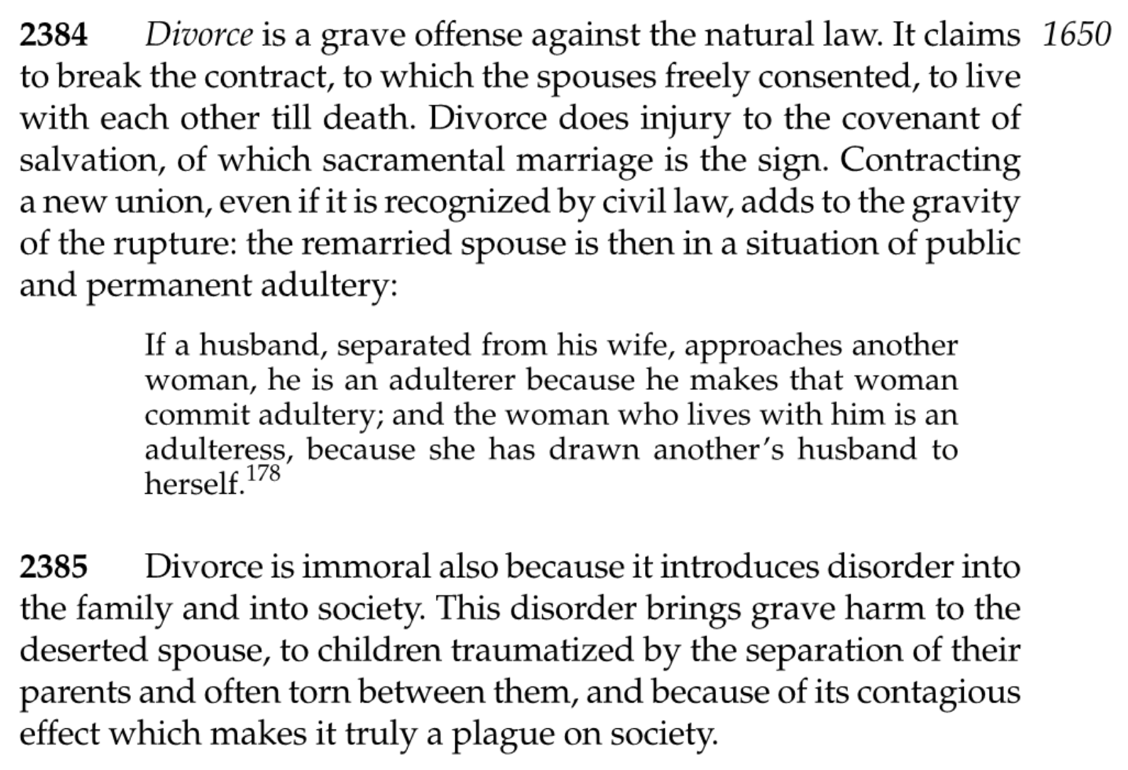
It seems that even though canon law says no such bond existed, divorce is morally prohibited, and thus you have to violate the moral law in order to take advantage of canon law. Sure, the bond might not be there, but if you have kids, the catechism explains how damaging the divorce is to the children and grandchildren, and the community as a whole. So that's a no-go. Even still if it were morally allowed and such was declared in the catechism to be so, a large number of many fathers wouldn't take advantage of it because they know it would cause serious, long-lasting emotional damage to their children above and beyond the emotional damage they receive if mom and dad split up. Dads know that if they split up, he can't be there to intervene when mom takes her problems out on the kids, or manipulates them, exploits them for her emotional validation. Furthermore, if she gets into a relationship with another man, single mothers with personality disorders tend to pull below-average men in the husband market.
All the systems within civil society and the Church have stacked the deck against men, tying their hands, and giving them no option but to stand there and take it like did Jesus on the Cross. Here's where that analogy applied thusly falls short. Husbands are told to love their wives as Christ loves the Church. Applied in this situation though, husbands are told essentially to let their wives to crucify them. The Church didn't crucify Christ. The Church was admonished, chastised, and upbraided by Christ. Christ even charged priests with the task of admonishing whose who do such harm to their neighbor, yet many priests are simply unwilling because they lack the moral clarity and intestinal fortitude to tell a woman that her behavior toward her husband is morally reprehensible and she risks her salvation by acting thusly.
What is a husband to do in all of this with the civil authorities and the Church standing against him in his marriage? It depends on the circumstance. There are some things that can be done to mitigate and diminish some of the issues of BPD, NPD, and sociopathy in wives, but it takes resolve, training, probably some counseling to help resolve some of the wounds from living in such a disordered state, and lots of prayer asking Jesus to be with you and guide you through this. Until other avenues appear, and the incentive structures for women are changed, many men will continue to live with their hands tied, seemingly trapped in loveless and abusive marriages.
If you find yourself in such a marriage, there are things you can do to keep from making the problem worse, maybe even make it a little better, and to get your mind right about the predicament that you're in. Complete the contact form for a free 15-minute video consultation.

